Did you know the first woman ever filmed was a flamenco dancer? When Thomas Edison caught her on camera in 1894 New York, ‘Carmencita’ scandalized the public with her sensuality. An inspiration to me as an artist and flamenco dancer, I am dedicating my flamenco novel to her. Join me as we step behind the scenes of Carmencita’s life in ‘Carmencita Part I: A first Peek’.
🔒🎁Al suscribirte, recibes la traducción completa de este artículo
© by Hannet Engel.
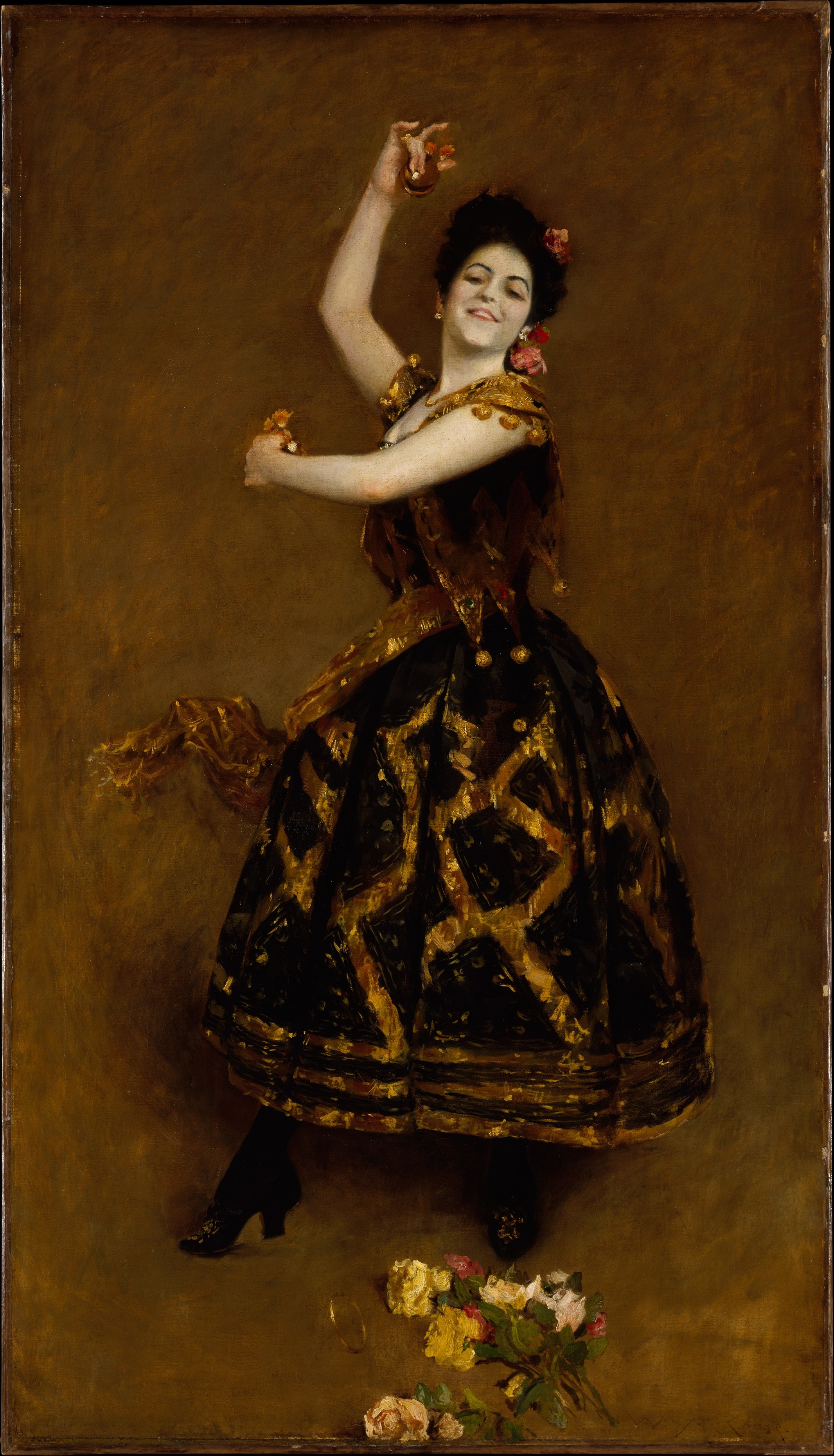
Carmencita, painting by William Merritt Chase, 1 January 1890, oil on canvas, 177.5 x 103.8, Metropolitan Museum of Art Boston. Public Domain
How Carmencita Inspired My Artistic Journey
Carmencita has inspired me to start writing a novel. Watching Carmencita whirl across Edison’s footage felt like stepping into a time machine. Her spirit seemed to leap off the screen, drawing me into her world. Through this cinematic peephole, I glimpsed a Spanish dancer whose charisma challenged the male gaze and catapulted her to international fame. It made me wonder: what was flamenco like in the 19th century?
Discovering Carmencita’s Legacy
I first encountered Carmencita’s film in a flamenco history class in Seville. Our teacher, Juan Vergillos, introduced us to this magnetic woman of flamenco and showed us the century-old footage. Imagine my surprise when I saw her elegant twists and flourishes, bringing 19th-century flamenco to life before my eyes. It felt like stepping back in time, witnessing history in motion.
Check out the vintage 19th-century flamenco film footage for yourself
Carmencita, 35 mm film, 21 sec, production: William Kennedy Dickson, camera: William Heise, Thomas A. Edison, Inc, New York 10th-16th March 1894. Source: Hendricks (Gordon) Collection (Library of Congress), US Edison Manufacturing Co
Flamenco in Art: A Painting Coming to Life
The first scene I imagined for my novel was a flamenco dancer stepping out of a painting—specifically, my favorite, El Jaleo by John Singer Sargent. This painting has an intriguing connection to Carmencita’s life, which I can’t wait to explore with you.
Writing a novel feels daunting, especially since it’s my first attempt, but it’s a creative urge I can’t ignore. Through art historical research and storytelling, I’m discovering Carmencita in new ways—both as a historical figure and as an artistic muse.
This year marks 130 years since Edison filmed Carmencita, making cinematic history. It feels like the perfect time to bring her story to life and share the intimate discoveries I’ve made along the way. Dive into her world with me—friend, guide, and inspiration. Stay tuned and subscribe for FREE to stay updated!
A sensational life: Who Was Carmencita?
Carmencita, a flamenco dancer from 19th-century Spain, forever changed the history of flamenco in cinema. Her bold performances and sensuality captivated audiences, making her both a pioneer and a muse. She lived it all.
Originally born in 1868 in the southern Spanish city of Almería ‘Carmen Dauset Moreno’ was a working class girl. She had an extraordinary talent for dancing from an early age. Later on she became a sensual vaudeville star, as well as a leading lady in a romantic novella. Moreover, she became a muse to famous American painters.
Does her adventurous life stop there? Certainly not. Carmencita had several copycats imitating her on stage, unwittingly confirming her fame. Then she supposedly became a victim of a crime passionel. And did you know she worked with a legend of flamenco singing ‘El Rojo el Alpargatero’? Combine that with her sensual, passionate way of dancing, her stunning looks, and her business savvy. I think you can see how she became a glamorous vaudeville star in the USA.
Carmencita: The First Muse of Cinema
In 1894, Thomas Edison—best known for inventing the light bulb—captured Carmencita’s performance on film in New York. This marked a groundbreaking moment: audiences saw not only flamenco for the first time but also a woman dancing on film. For decades, this pioneering dancer remained anonymous in cinematic history, until Spanish researcher Kiko Mora identified her in 2010. He aptly christened her “the first muse of cinema.”
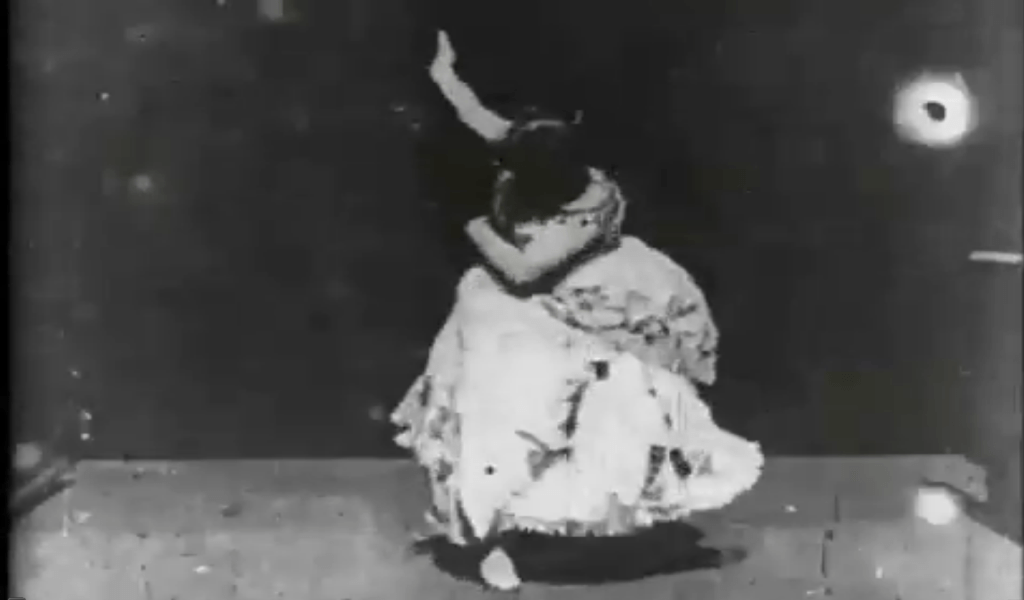

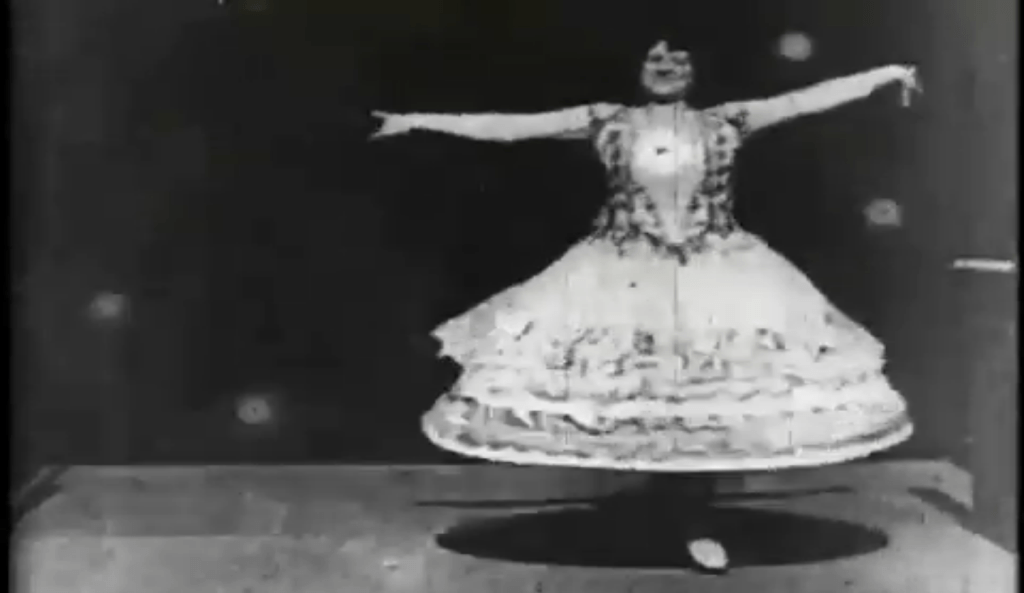
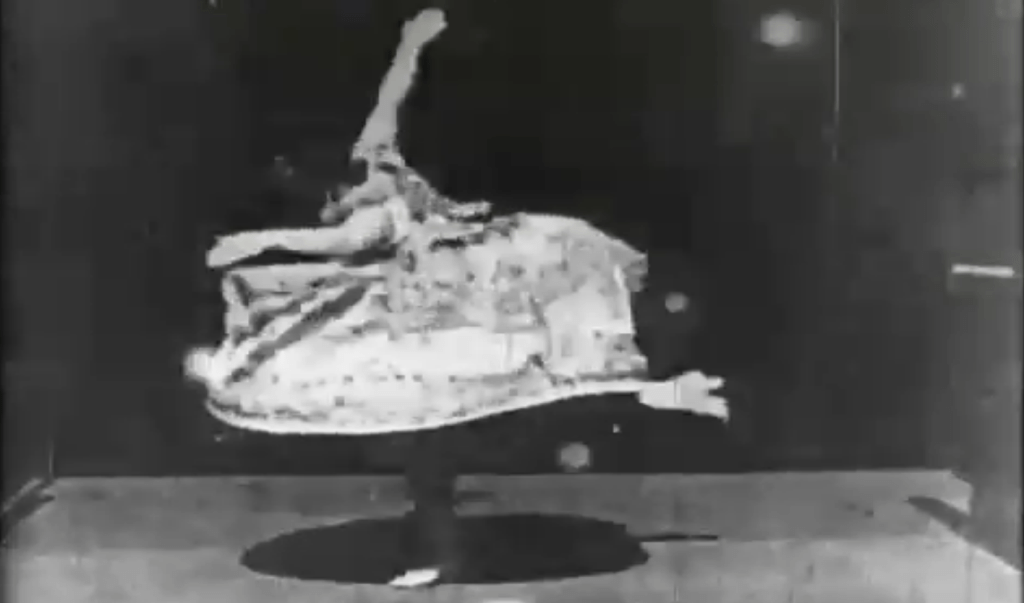
Edison’s experiment: a scandalous Spanish dancer
Carmencita was the first woman to appear on film. She was also the first person in movie history to face censorship. Why? Her ankles were showing—oh my, quite the scandal!
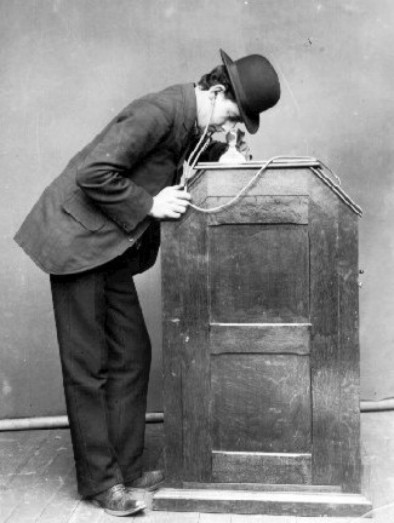
Edison filmed her in The Black Maria, the world’s first film-production studio: a makeshift tent that served as a testbed for his latest invention, the kinetoscope. This motion picture device entertained viewers with short films, seen through a peephole at the top of a wooden box.
A Fascination with Voyeurism
Voyeurism in art and literature has fascinated me throughout my artistic career. I love how they can evoke a sense of secretly watching from the shadows to suggest eroticism. It adds a scintillating spark to my artistic mind, and I will certainly explore it further in my novel.
I tickles me to think about the intimate peephole viewing that people must have had of Carmencita. Seeing her bold movements and skirt whirling, especially the moments her elegant ankles pop out from under it. An experience like that probably amplified the voyeuristic allure of Carmencita’s performance. The result: shocked audiences upon the film’s release. The backlash was so strong that the film was eventually prohibited.
Carmencita in a saucy pose. Photo from Terry Ramsaye's article in Photoplay, May 1922, p.33.

The Rise of Carmencita on Broadway
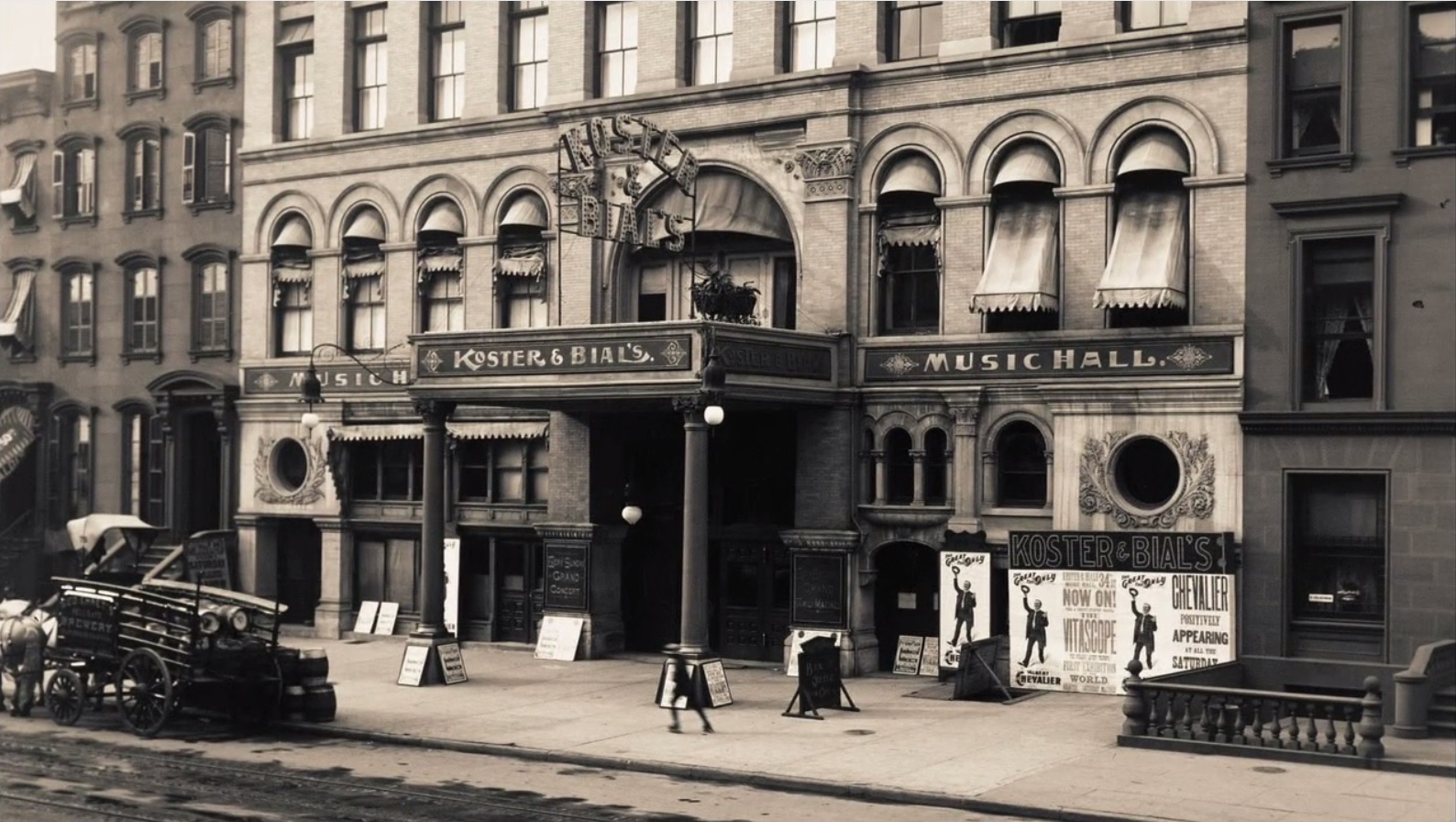
How did Carmencita get to America? American impresario Bolossy Kiralfy was the one to discover Carmencita in Paris, at the World Fair 1889, and he brought her to New York.
Carmencita had her first real succes in Koster & Bial’s Music Hall on Broadway. Sometimes her dances only lasted for five minutes, but the press was wildly enthusiastic about Carmencita’s supple and passionate movements. Carmencita was an allround artist and even sang and played the guitar as well. Koster and Bial’s provided her with regular shows, as well as paid performances at parties. And Carmencita got to teach private lessons to daughters from well-to do families.
New York, New York
The stardom that Carmencita eventually reached in the USA was a first in the world of flamenco. Flamenco dancer ‘La Cuenca’ had her moment of fame in New York as well, in 1888, one year before Carmencita arrived. But it did not last long and didn’t rise to the point of popularity the way that the ‘Carmencita craze‘ did.
An american journalist describes her rise to fame animatedly:
[…]
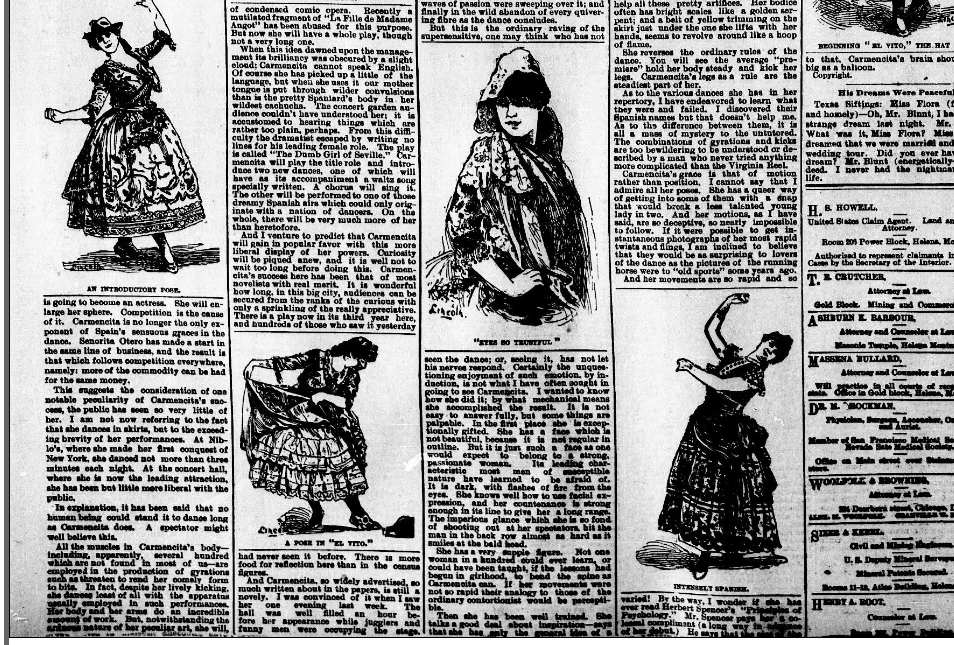
“When Carmencita first came to America she traveled with the “ Antiope” company, and no one paid any particular attention to her. Then she was employed to dance before the patrons of a big New York beer and music hall, and somebody suddenly discovered that she was a phenomenon. At once that concert hall enjoyed such a boom as it had never known before. Every one went to it – rich and poor, high and low. Fine ladies sat in the boxes, heavily veiled and half stifled with bad tobacco smoke, in order to see the big eyed Spanish woman wriggle and cavort for a few moments on the stage and fine gentlemen applauded her strange, graceful movements until they cracked their gloves.
Moreover, she became a great drawing room attraction. Hundreds of dollars were paid her for dancing a dozen or two Spanish steps in the parlors of the rich, and altogether Carmencita had a gay time of it.”
[..]– Capital city courier, December 12, 1891, Page 4.
I am constantly imagining what it would be like, being the audience of a Carmencita show, stage lights shining, and on she comes: the latest Spanish dancing phenomenon of Broadway. Tell me, how do you, my readers, imagine you would have experienced Carmencita’s shows?
Flamenco or Not?
However enthusiastic I am about Carmencita, I keep wondering: was she truly dancing flamenco? Let’s focus the lens a bit.
Are you enjoing your read and want more? Unlock the full post by:
- Subscribing to my free newsletter or
- Booking an online coaching session with me for a personalized ‘Flamenco History Class’ or ‘Creative with ChatGPT‘ >> fill out the contact form
→ Subscribing to my free newsletter
or
→ Booking an online coaching session with me — choose between a personalized Flamenco History Class or Creative with ChatGPT. Just fill out the [contact form].
Extras for subscribers ✦
- Una traducción completa de este artículo en español/A full Spanish translation
- My literature notes (sources & annotations) 📖
- A rare 19th-century photo of Carmencita
Subscribe and read more about : Carmencita: Pearl of Seville
🔒 Subscribers get full access to my AI-generated art prompts, insider flamenco writing techniques, and more creative tools!

Subscribe to continue reading
Subscribe to get access to the rest of this post and other subscriber-only content.
 FLAMENCO ARTWORKS © |||///|||///||| |||///|||///||| HANNET ENGEL
Comments are closed.